
By Andre / May 18, 2026
What Happened After I Switched to Actual Budget
I can’t say it enough, but YNAB and Actual Budget are great tools (I’ll even give a shout out to Firefly). If you are getting the feeling that something has changed, then you are correct.
I ran into two issues, filed my taxes, and realized an upcoming deadline was going to force me to rethink both my process and the software I depended on.
- My bank only offers CSV exports (at the moment, but they have not been clear on their new version, which is being released this summer)
- There is a bug that causes a drift in a major feature of Actual Budget, the budget. To be fair, software bugs happen. The issue for me was not that it existed, but that it affected the one area where I need complete trust: the numbers.
- I plan on migrating from Wave Accounting for my business accounts at the end of the year (that will be a fun exercise for November/December)
The more I relied on imports, the more I realized that reliable import quality mattered more than automatic bank syncing.
Actual Budget Led Me to Write OpenStatement
There are multiple banks that offer CSV exports as a method to import transactions into your financial software. A bank we use for a majority of our transactions offers a low-effort version of CSV exports, and I wrote a Python script to clean it up, but there are still limitations with this method. Even if you clean up the file, you still risk duplicate entries, and that is unacceptable.
There is a brilliant library called csv2ofx that does a great job of converting CSV files to usable OFX files ready for import. Having a clean import will set you up for an improved experience in YNAB, Actual Budget, HomeBank and many others. Well, I had a few hours to put something together to add some quality of life improvements and make csv2ofx more accessible to others.
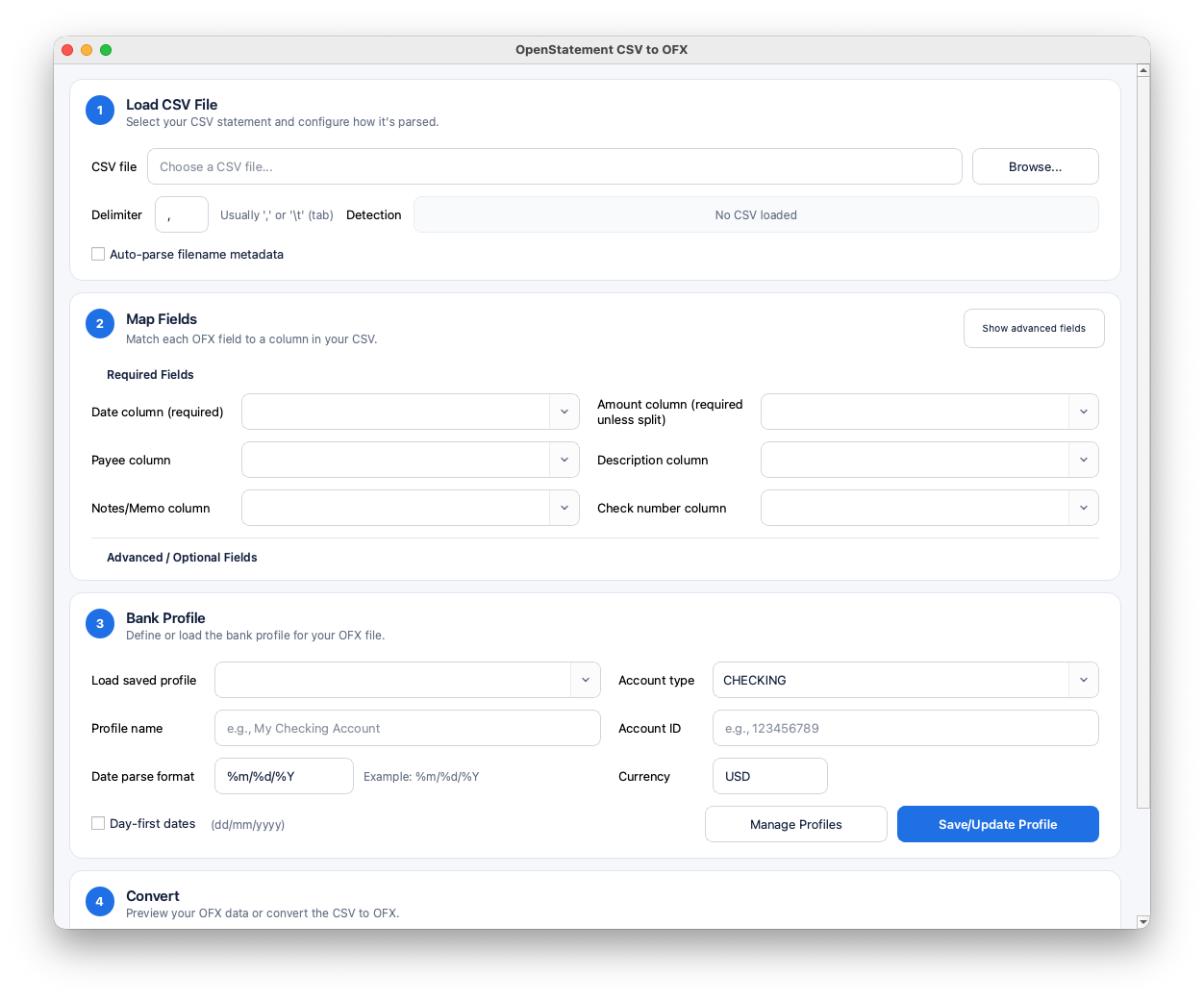
- Desktop GUI for CSV-to-OFX conversion using
csv2ofx - Auto-detects and maps common CSV headers (date, amount, payee, memo, ID, balance, etc.)
- Supports both a single amount column and split debit/credit columns
- Saves reusable bank profiles including mappings, date options, delimiter, and account settings
- Auto-detects likely saved profiles from CSV headers plus parsed filename metadata
- Optional filename metadata parsing with customizable patterns (account, statement date, ending balance)
- Validates mapped columns against the selected CSV before conversion
- OFX preview dialog to inspect parsed transactions before writing output
- Adds missing OFX metadata when available (
ACCTID,LEDGERBAL/BALAMT,LEDGERBAL/DTASOF)
Problem solved.
OpenStatement is available on GitHub here: https://github.com/apowell656/csv2ofx-gui
The Math in Actual Budget Stopped “Mathing”
I am not sure what the cause of the bug that affects imports is, but I spent way too much time trying to clean it up. I am sure the developers will fix it, but I will be honest, I did not want to experience it again. We need to have trust in our numbers so that we can make confident decisions.
This is not a knock on Actual Budget and I still recommend it, but while working through this issue, I realized something. Well, actually, two things changed: the software I needed and what I needed it to do.
- I needed solid accounting software. Accurate numbers have always mattered more to me than “cool features.” I will look for 5 cents.
- The tool needs to help me communicate our position clearly. I switched to YNAB because it improved communication with my wife about our finances. In our household, I am the person who maintains the financial system. What mattered more was having a process that stayed accurate even if nobody touched it for several days.
Enter GnuCash
I had used GnuCash in the past (it was my preferred tool after Quicken back in the day), and was running my business finances with it before switching to Wave Accounting (really just for the invoice integration). It has always been solid with a few exceptions:
- The budget module used to not have a “Remaining to Budget” amount (I am not sure when that changed, but I am glad it did)
- The reports and dashboards need some love
Although I am a nerd, I will swap out personal finance software at the start of any month. All I need is a starting balance. So on May 1st that’s what I did. I couldn’t be happier. Or could I?
A Functional and Actionable Financial Dashboard
If you can’t manage what you don’t track, then the most important information needs to be readily available.
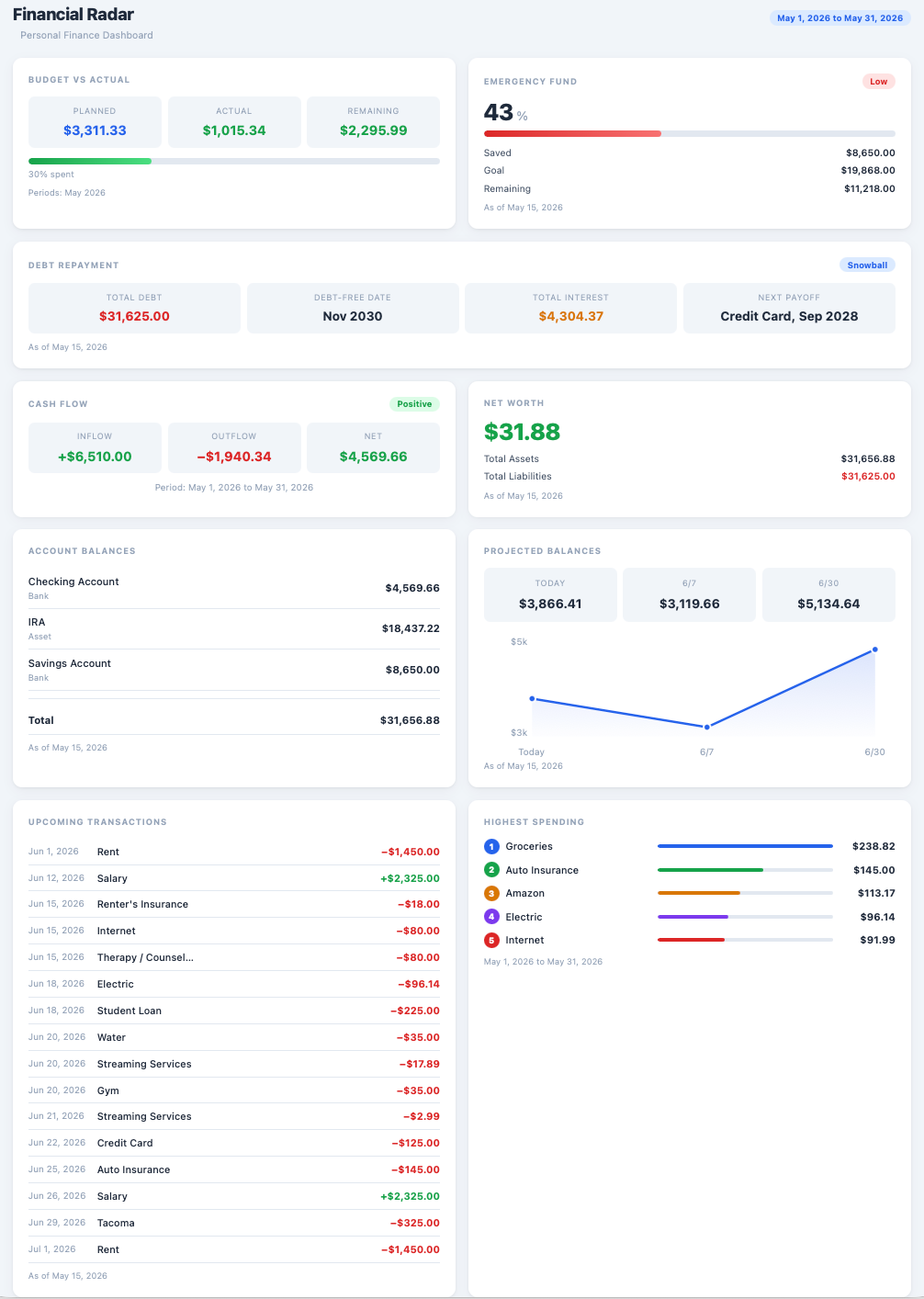
- Budget vs. Actual - Tracks your planned expenses against what has actually been spent.
- Emergency Fund - Configure either a set dollar amount or X months of spending “tucked” away.
- Debt Repayment - Summary of your plan to eliminate your debt. Configurable to use the snowball, avalanche, or custom methods of debt elimination.
- Cashflow - Snapshot of, you guessed it, cashflow.
- Net Worth
- Account Balances
- Projected Balances - Pick the account(s) where you spend money and see how scheduled transactions affect your balances (tied to the date selected in Upcoming Transactions).
- Upcoming Transactions - A preview of scheduled transactions that can be figured to see the end of this month, next month, or another custom range.
- Highest Spending (Categories)
Modernizing the Gnucash Budget Report
Your budget is not just for planning, but it can serve as a communication tool. YNAB and Actual Budget have some tricks up their sleeve that help in the communication of budget progress.
Natively, what GnuCash offers meets the mark. I mentioned before, “Remaining to Budget”, and in the past I had to pull two reports or keep a calculator handy to know where each penny needed to go. Well not any more.
What I needed was a cleaner layout with indicators/triggers. Both YNAB and Actual Budget do this cleanly so the next step was to duplicate the “spirit” of this functionality in GnuCash.
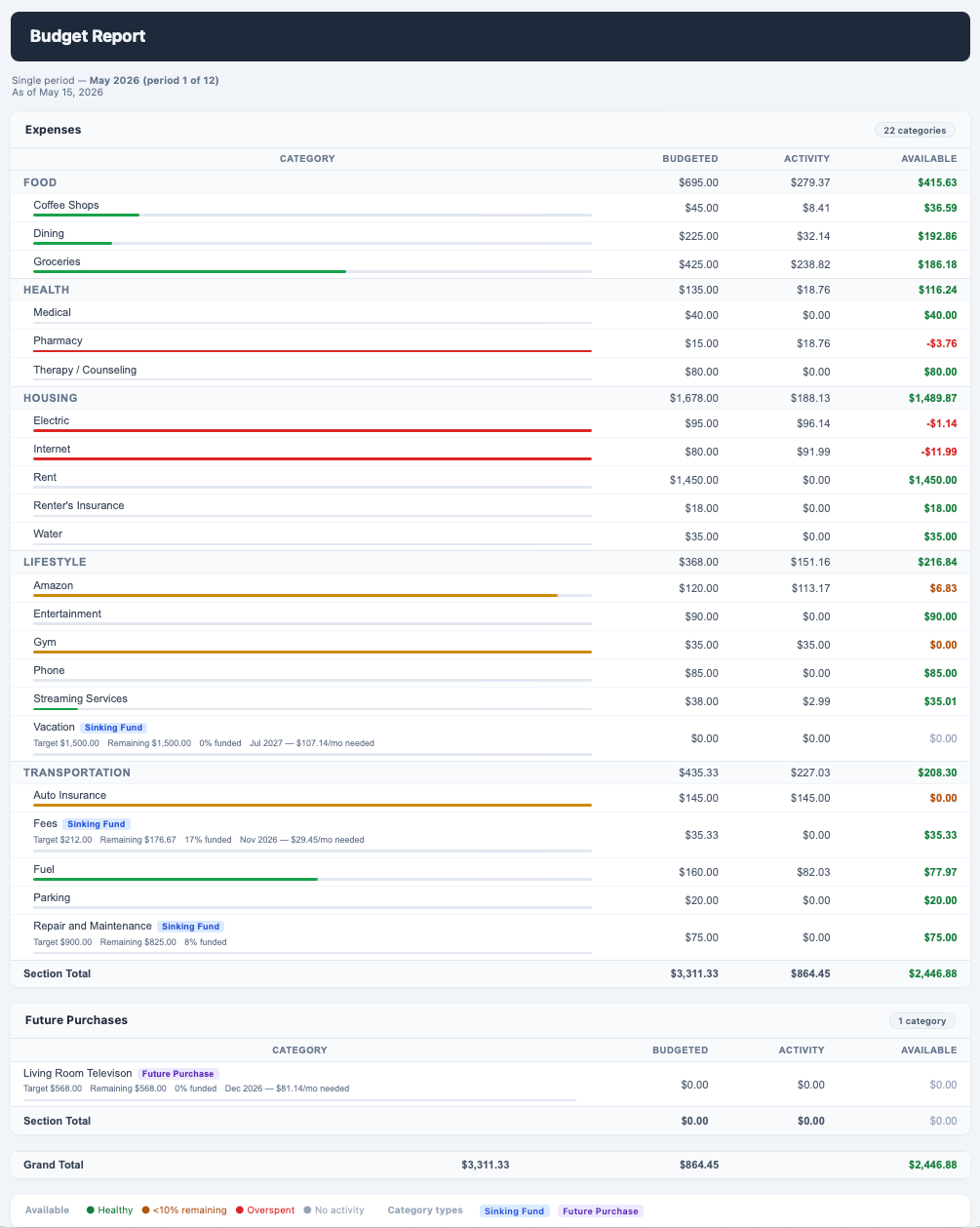
- Sinking Funds - The big expenditures that happen every year.
- Future Purchases - The expenses that you want to simply plan for.
- Carryover Amounts - Your budget shouldn’t penalize you for setting the money aside in your budget.
GnuCash Needs a Way to Display Debt Repayment (So Do I)
Spreadsheets, Undebt.it, and miscellaneous apps outside of your personal financial tool don’t make sense to me. They cause friction. If the numbers are there, show me the results.
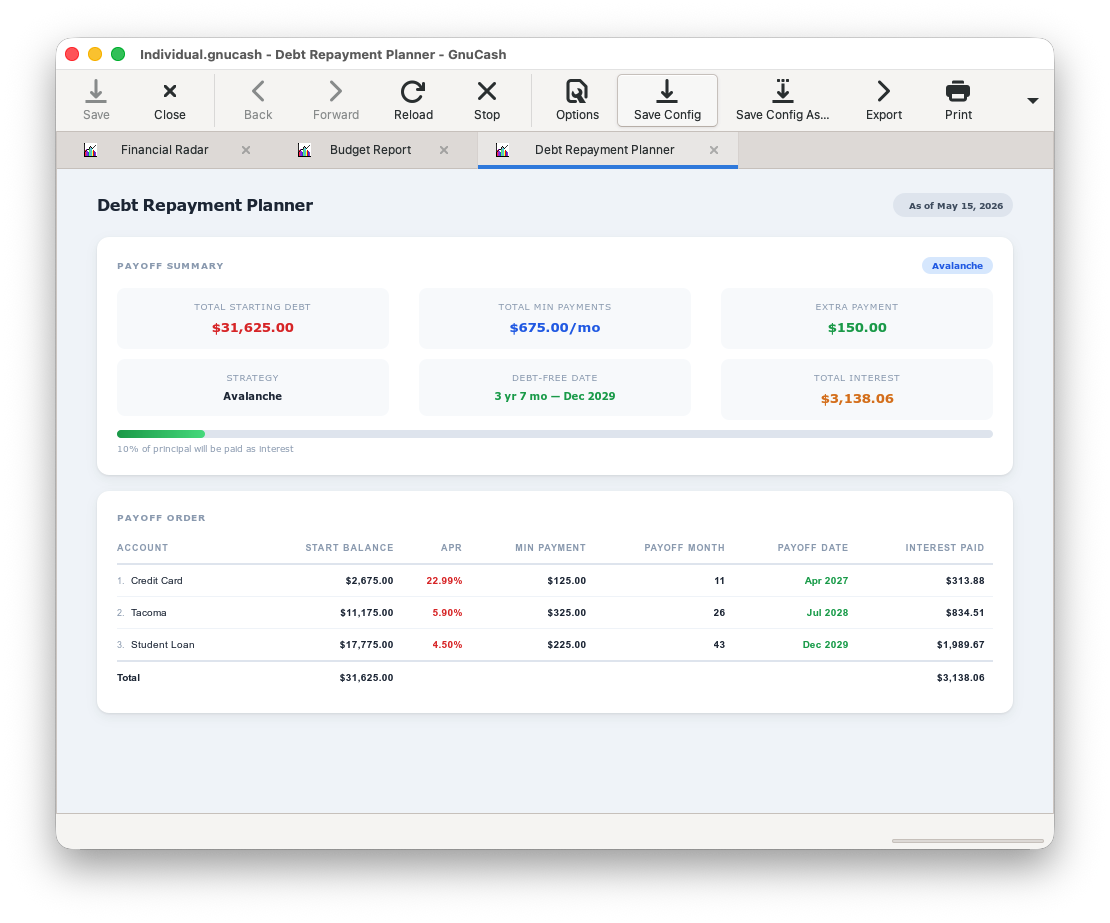
- Select the debts you want to pay down
- Pick a method that works best for you
- Add additional money to accelerate your progress
Managing My Finances Became Routine Instead of Stressful (Again)
I don’t need my financial software to be exciting. I need it to be trustworthy, understandable, and sustainable.
These days, importing transactions three times a week, reconciling accounts, and reviewing my dashboard feels less like maintaining a system and more like part of my normal routine again.
For me, that has been the biggest improvement of all.
The GnuCash dashboard/report modifications are available here: https://github.com/apowell656/gnucash-financial-radar
